
Trainer's manual
- Role Of The Trainer
- Development of your own philosophy
- Basic Athlete Expectations From the Coach
- Fundamentals of Periodization of Education
- Sensitive Times Suitable For Training Various Skills And Abilities
- Training Styles And Learning Methods
- Communicating With The Players And Parents
- Instructor's Code of Conduct
More details:
Der moderne Trainer stellt im wahrsten Sinne des Wortes eine Verbindung zwischen Wissenschaft und Praxis her und bestimmt deren inhaltliche Seite durch das Prisma seiner Erfahrung. Daher ist es kein Zufall, dass die besten Trainer, die mit der Wissenschaft Schritt halten, nicht nur bemerkenswerte Erfolge in ihrer pädagogischen Arbeit erzielen, sondern auch die wissenschaftlichen Grundlagen der Theorie und Methodik des Sports erheblich bereichern. Der Trainer ist die zentrale Figur der Sportorganisation. Sein Bereich und seine Aktivitäten sind sehr breit, so dass er die Funktion eines Lehrers für technische Elemente einer Sportdisziplin übertrifft. Dies erfordert natürlich, dass der Trainer das Spektrum seiner Kenntnisse und Interessen erheblich erweitert. Ein guter Trainer gibt sich mit soliden technischen Kenntnissen einer bestimmten Sportdisziplin nicht zufrieden, sondern muss sich auch bei den Elementen der Psychologie, Soziologie und Medizin gut auskennen, aus dem einfachen Grund, weil seine Funktion mit diesen Gebieten eng verbunden ist.
Der Beruf des Trainers ist sehr komplex und multidisziplinär. Unabhängig vom Fachgebiet des Trainers, er muss die Grundkenntnisse auf vielen Gebieten beherrschen. Er muss eine reife Persönlichkeit sein und sich seiner Aufgabe bewusst, die sehr verantwortungsvoll ist, weil er einen riesigen Einfluss auf die Sportler allgemein hat.
Perhaps some coaches, mostly young and inexperienced, are rightly asking themselves: "What should I do with philosophy, it's not my job to philosophize in vain, but to organize and lead training sessions to prepare athletes for competitions?" R. Martens provides the answer to these and similar questions, reminding such trainers that their profession is full of situations in which difficult decisions must be made and ethical dilemmas resolved. The role of a well-developed training philosophy is to help coaches to make such difficult decisions more easily, not succumb to external pressures, not violate their moral and professional integrity, successfully meet the demands of the training, and relationships of build mutual trust and respect with the athletes and build a successful coaching career.
In order to successfully fulfill the requirements of their base role, ie to become a good sports skills teacher, the coach must have a good knowledge of the sport he is coaching. Most coaches get their basic knowledge about sports from their own sporting experiences, and from their previous personal sporting activities.
However, it is often wrongly assumed that only those people who have previously been the most successful athletes can become good or very successful coaches. Of course, it is desirable that the coach himself played sports and mastered the tactical skills of his sport. But that's not enough, he has to know his sport well and at the same time be able to successfully pass on the knowledge he has acquired to athletes!
Bompa (28, 29), one of the most well-known contemporary experts has been very successful in addressing the essential issues of periodization and programming of all aspects of sports training for athletes of different ages, sports experiences, sports, and levels of competition poses one of the most common used periodization schemes of long-term athletic development.
Table periodization of long-term sporting development and children's training from the start of sport to top-level sport (adapted from Bompa, 28, 29)
| Periodization of training | |||
|---|---|---|---|
| Multilateral training: 6-14. year | Specialization: from the age of 15 onwards | ||
| Initiation - introduction to sports: 6-10. year |
Shaping, development of the athlete: 11-14. year |
Specialization: 15-18. year |
Top performance: 19 and over |
| Before puberty | Puberty | Post puberty and adolescence | Maturity |
As can be seen from the table, the initial period refers to the age of 6 to 10 years, when children most often engage in sports, mainly due to the desires and needs for play, fun, excitement, socializing, trying and learning from something new. Research data shows that the largest percentage of children, 67.8% to be precise, are involved in sports between the ages of 6 and 10. In the initial phase, as well as in the phase of athlete formation, Bompa recommends low-intensity multilateral training, the aim of which is to positively influence all aspects of a young athlete's psychophysical development. It should include various motor skills (running, swimming, jumping, throwing, catching, balancing, turning, rolling) to develop flexibility, balance and coordination, to contribute positively to the functioning of the cardiovascular system and aerobic and anaerobic to develop skills. Especially training programs in the first two phases.
The term periodization of training work implies the division of the total duration of the competition season (or the corresponding longer or shorter time cycle) into shorter time periods. The basic function of periodization is reflected in the need to respect the physiological laws of the cumulative effects of training load on the athlete's body in order to optimize the impact of the load on improving the athlete's form and avoiding overtraining.
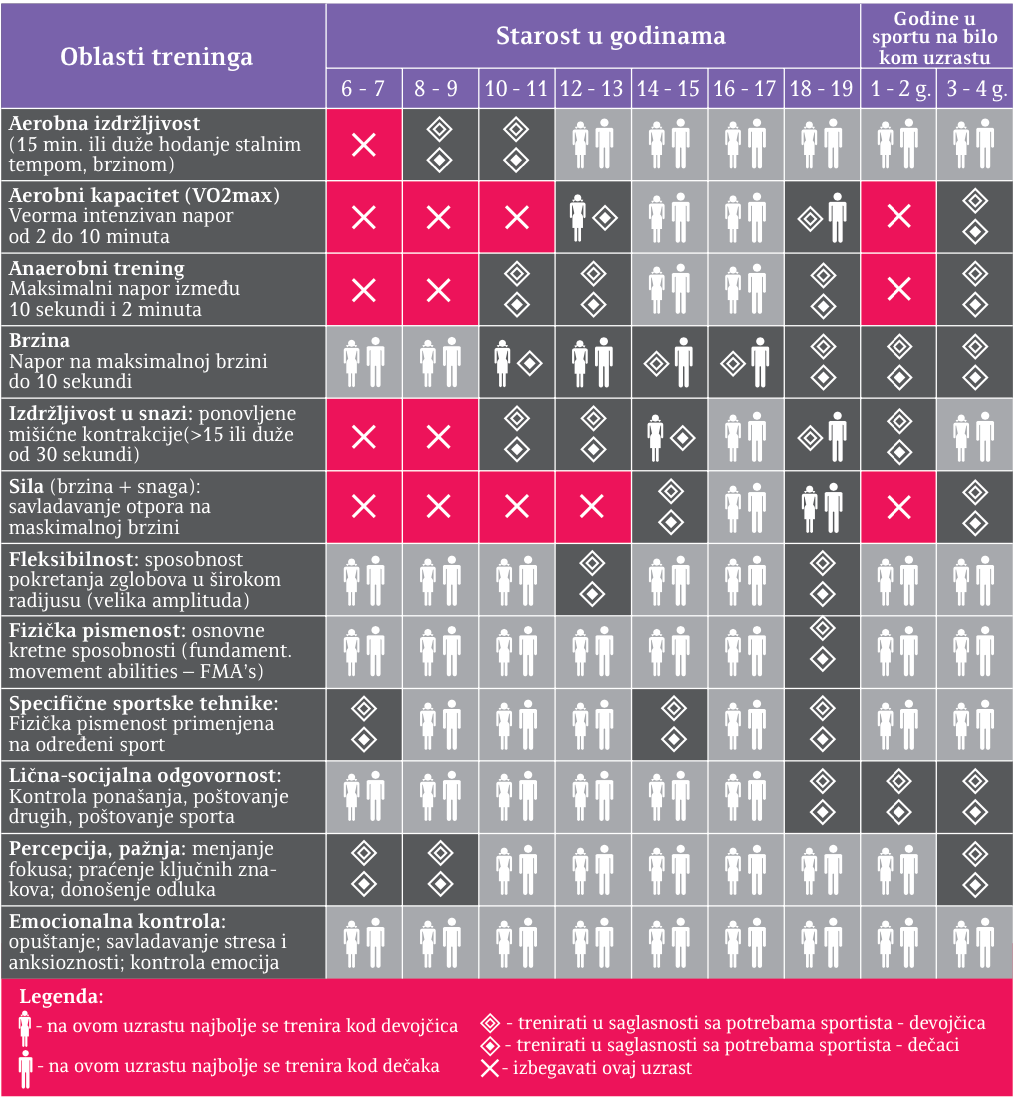
In the training process, trainers use different styles. Which training style should be chosen depends on many factors, such as personality traits, the extent and quality of the available knowledge, reasons for exercising the activity as a coach, personal coach philosophies, previous personal sports experiences, how they were coached and the like.< /p>
Beginner coaches often use methods they have experienced as players/athletes or that have been used by other coaches. This way of choosing a method can give good results if the former trainer whose method is being "copied" was a good educator. Unfortunately, this is often not the case, leading to the paradoxical situation of unwanted practices being propagated and repeated.
To choose an appropriate training style, coaches must consider the learning abilities and opinions of their athletes, as well as the learning styles preferred by the athletes. Coaches are developing the preferred way of training their sport and there is a risk that they can focus solely on activities that will forget that they are training children who are being taught not only to learn certain activities but also to learn must. The art of successful training is a mixture of content and context. It consists of knowledge, good communication, positive interaction in interpersonal relationships and leadership (Lautzenheiser). A good coach motivates their athletes and makes monotonous training sessions with many repetitive exercises interesting, challenging and fun. In a word, he knows how to choose a training method and creates a working atmosphere that turns even the most boring and difficult exercises into interesting, stimulating and purposeful learning.
Different sports experts cite different numbers of authentic training styles based on their own practical experience of training and theoretical knowledge of the psychology of learning and sport. Rainer Martens (82), who has made the greatest contribution to the successful training and leadership of young athletes, talks about two basic styles of training: traditional (traditional approach, instructional or coach-oriented style) and games-based approach (method of guided discovery, centered on the student). Rosemary Connell (45) also cites two styles of training: practice style and reciprocal style.
People learn to think through communication. Therefore, in our program we use not only the offensive and defensive system, but also the communication system. (Mike Krzyzewski, coach of the Duke University men's basketball team).
It's not what you told them - it's what they heard (Red Auerbach, former Boston Celtics coach).
“Training is communication. Successful coaches are masters of communication, and unsuccessful coaches often fail, not because they lack sports knowledge, but because they have poor communication skills." Other sports psychologists (Yukelson, Carron, Horn, Jowet, Orlick, Smith, Smoll and Curtis, Harris and Harris, Anshel) also pointed out that effective communication is key to the success of any team, organization and its members. It affects attitudes, motivation, expectations, satisfaction, team cohesion, team success, training effectiveness, feedback and reinforcement principles, conflict resolution skills, and overall behavior. The ability to effectively express thoughts, feelings, and needs, and to understand the thoughts, feelings, ideas, and needs of others is central to good communication.
Communication With Parents
Our sports practice is rich in examples that show that in the relationship between coach and parents many things are "not right", that there is a high level of mutual misunderstanding, distrust, accusation and criticism. Neither side is satisfied, the differences in understanding of their own roles and responsibilities in relation to the role and duties of the other "side" are great, and confrontations and conflicts are inevitable. Such dysfunctional relationships are an indicator that communication between coaches and parents of their athletes is poor or almost non-existent and that communication channels are blocked.
When the relationship between parents and coaches is disrupted, young athletes suffer the most, becoming confused and annoyed by wildly different messages and demands coming from two opposite sides.
The code of conduct for coaches in a club or organization is a very important thing and any serious organization should have it as a set of rules. Coaches, like everyone else, face different temptations and there should be clear boundaries within which to work. It is the duty of every employee to create a positive image of themselves, a colleague, their organization and the National Water Polo Association. This beautiful image becomes the status symbol of every player and member of the club and needs to be taken care of in a special way. This improves the environment in which athletes train and compete, and everyone approaches it with a sense of respect.
It is essential to cite the following points of the code of conduct and the responsibilities of the trainers:
- I will always be aware that I have a major positive and/or negative influence in the upbringing of young athletes and therefore I will never place the value of victory above the value of building ideals of high character. Teach your players what equipment they need for training, a match or traveling with the team.
- I will never forget that young people play sports for pleasure, love and learning, and winning is only part of that process. The basic principle of my coaching philosophy is therefore: "The athlete is primary - victory is secondary".
- I will uphold the honor and dignity of this noble profession. In all personal interactions with athletes and students I coach, with opposing players, experts and board members, referees, sport and school officials, other officials, the media and the public - I will try to set an example of the highest ethical and moral behavior give.
- Be aware of your role as a coach as you are both an educator and a role model for the players. Take care of your appearance and your clothes. Coaches are often an example for young players in life and your behaviour, communication and positive approach are very important for young players to learn. With your knowledge, commitment and behavior you set an example for the players, parents, the club management and the public. Good manners and respect can be contagious. Do not criticize other team members, rivals, officials and accept defeat with pride and applause. Coaches have a significant impact on the way sport is played
- Teach them how to pack their belongings, how to maintain hygiene, and how to treat equipment. In all of this, give them a personal example.
- As a coach, you are responsible for all players during training, travel, preparation and competition. For your health and safety. Teach your players the rules of conduct for training, transportation (bus, train, plane...), preparation or competition, because when you are part of your team, they represent your team - the city, the state, the state from which They come from.
- Teach your players that playing by the rules and learning those rules is their own responsibility and that rules exist to ensure water polo is fun. The lessons learned in water polo are the lessons that will guide you through life. Never allow players to ignore or intentionally break the rules. Remember that water polo is played for fun and winning is only part of motivating players. Always try to make all players feel good when attending a practice session or a game.
- Teach players to respect the referees' decisions and to understand that the referees are part of the game and that they are there to enforce the rules of the game, but that they cannot always be right and that it is human , To make mistakes. Criticizing judges is unacceptable behavior that will not be tolerated. The coach is always responsible for the behavior of the players. Demonstrate appropriate social behavior without using inappropriate language insults directed at players, referees, parents or officials. There is no place for inappropriate social behavior in water polo.
- Sometimes be prepared to lose. Everyone wins and loses, you have to be a fair winner and a good loser. Disappointment after a loss is natural, but it shouldn't be a problem. Realize that even if you lose, the loser accomplished something just by playing. Not everything in life can be a win situation. Failure can be a significant learning experience for larger life goals. Teach your players to accept defeat in that spirit. Teach your players to accept that their opponents also have the right to win. That means congratulations after the game, regardless of victory or defeat.
- Plan your training carefully and combine opportunities for individual and team progress. Be prepared to change your training schedule if you notice unexpected interest in a particular activity. Create a daily, weekly and monthly training plan, record the arrival of all players, submit a monthly report on the implementation of the plan and program, the results, problems and proposed solutions.
- When planning training, be aware of your player needs for time, energy and enthusiasm, taking into account their age, level of play and other commitments such as school and family time. Small children will likely have more time, but lack focus and attention, have a lot of energy, but will likely need more guidance in their work. Older children have higher demands at school and an excess of social interests. Try to help them strike a balance between different needs.
- Always be positive in your support for the players. Never yell at players, especially young players, when they make mistakes during practice and games. See failure or failure as an opportunity to fix things in a constructive way. Positive support for players will encourage them and most likely spur them on to play better. Comment on everything positively and in a way that encourages player interest, engagement and development.
- Ensure each player gets a certain number of minutes in the game. All players deserve to feel the game. If less talented players don't come into play, they quickly lose interest in water polo, change clubs or leave the sport.
- Remember that there are different levels of maturity in children of the same age. Make sure that changes in altitude and other physical changes are recognized in good time. Act responsibly when players are ill or injured. Show care and take responsibility for players who are ill or injured and always listen to doctor's advice. Do not experiment with exercises that could harm and endanger the player's health.
- Avoid personal intimacy with players or their parents, this may be considered inappropriate.
- Respect the rights, dignity and worth of every person. Regardless of gender, ability, cultural background, religion or any other factor not relevant to the practice or game, all people associated with water polo are entitled to equal treatment and respect. Avoid statements that could be construed as offensive or discriminatory. Sometimes even a joke can offend. Being discreet and careful is better in many situations. Your players will most likely follow your example in such situations.
- Never criticize colleagues, you are obliged to cooperate with them, to abide by the rules of the competition, the normative actions of the club, to work closely with the coordinator of junior teams, the club secretary and the club board, the plan and implement the selection program. You are required to attend the regular monthly meetings with the coordinator. Fulfill the obligations imposed by the association for the normal functioning of the association. At the competition, greet colleagues, judges and delegates with general respect.
- Respect the use of facilities and sports equipment. The facility and equipment will only cost and work if they are kept in good condition. Make sure nothing intended for use is misused. Ensure that the balls and props are returned to the cages after training, that all balls are present, that the hygiene of the hall, gym and locker room is maintained. Be sure to arrive 15 minutes before training and be the last to leave after checking that everything else is fine.
- It is unacceptable to come to exercise under the influence of alcohol or opiates. You are not allowed to smoke in front of players before, during and after practice. It is strictly forbidden to use a mobile phone during training. Behave civilly in public life and in accordance with sports ethics (consumption of alcohol, tobacco and drugs is prohibited, as well as night outings in the season of intensive preparations and competitions).
- Never hold and charge individual training allowances for players from the club (association) and do not demand benefits/money from parents. Do not comment on the work of colleagues or players who are coached by another coach. Do not comment on the work of the association (association) publicly and via social networks and keep all business data of the association (association).
- The coach must never intentionally lose a game.
- Avoid all gatherings with excessive content.
- Avoid associating with people with uncivilized and violent behavior.
- Arrive on time for any announced social gathering, competition or other association meeting.
- Any absence, lateness or early departure from training, competition or any other form of socializing must be announced to the club (federation) and justified.
- During training you are in the equipment of the club (association), schedule and equipment.
- During the training, do not talk too much with colleagues, just focus on the exercises and make corrections.
- Avoid wearing jewelry (large rings, piercings, large necklaces...) as these are not and must not be part of sports equipment. Huge tattoos should not be unduly highlighted.
- Never discuss problems of the club (federation) or the problems within the team in front of people outside the club (federation) - the place for such discussions is the dressing room or the meeting and not the hallway or electronic media such as social networks and the like.
- Constantly educate yourself and make progress. It is compulsory to attend lectures in the field of continuing education in health and anti-doping (NADA, etc.)
- Be an example to others, both inside and outside the team or club (association), through your conduct, your efforts and your way of life.
- Respond to all national team (or national association) invitations and present "this invitation" to all players, club members and beyond as the greatest honor and obligation.
- Support any of your (club) players who have been invited by the national association to get involved in the work regardless of club commitments. The invitation of the national association is to be seen as the greatest honor and the player is to be influenced to follow it in the best of spirits.
 water_polo_innovations